Showing posts with label (khmer news) phnom penh post. Show all posts
Showing posts with label (khmer news) phnom penh post. Show all posts
Bhutan steps lightly towards global village
Monday, 23 November 2009
THOUGH sandwiched between emerging superpowers China and India, Bhutan is a country that has proceeded with extreme caution on the path to globalisation. Television and the Internet did not arrive until 1999, and traffic lights in the capital were removed after the public deemed them a nuisance. Tourism is limited to high-end tour groups in which individials pay upwards of US$200 per day, ensuring that the backpacking hordes that descend annually upon neighbouring India and Nepal do not trample Bhutan as well.
Most notably, Bhutan eschews gross domestic product (GDP) as an indicator of national well-being, subscribing instead to GNH – gross national happiness – a concept first articulated by King Jigme Singye Wangchuk in 1972.
It may have seemed peculiar, then, when a six-member delegation from Bhutan, a nation so careful about controlling international influences, arrived in Cambodia last week to meet with government officials and business leaders to learn about the Kingdom’s experience as a member of the World Trade Organisation. After 11 years as a WTO observer, however, the hermetic Himalayan nation is now hoping to secure full membership for itself and extend its international ties.
Sonam Wangchuk, a delegation member with the Bhutanese trade department (no relation to the royal family), said that although Bhutan is mindful of preserving its traditions, ascension to the WTO is a necessary and inevitable part of sustaining the nation’s well-being in the long term.
“For Bhutan, whether you join or not, you’re already impacted internationally with globalisation. You’re dealing with the international community,” he said.
Wangchuk explained that Bhutan hopes the WTO framework will provide the predictability desired by foreign investors to a country whose private sector has been described by observers as disorganised. It could also spur the sector’s development, an essential element of poverty alleviation for Bhutan, said Tom Maxwell, a professor at Australia’s University of New England and programme director of the school’s Bhutan Project.
Though Bhutan performs very well against other UN-termed least-developed countries (LDCs) in measures such as political transparency, public health and education, youth unemployment and rural poverty are pressing concerns.
“Urban drift is already occurring as students get educated, but the private sector has not taken up the challenge,” Maxwell said.
Learning from Cambodia
After meeting with officials from the government and the UN Development Programme on Wednesday and Thursday, the Bhutanese group took Friday to tour Cambodian small businesses that might serve as models for prospective Bhutanese exporters.
First up was the Cambodia Organic Agriculture Association (COrAA), where the delegation discussed plans to expand Bhutanese agriculture into the organic export market.
“Seventy percent of our people are still in subsistence farming, but we’ve made a lot of progress in cash crops,” said Sonam Wangdi, director general of Bhutan’s department of trade, citing his country’s cultivation of apples, oranges and potatoes.
“You’re small, you’re specialty – I’d target the high-end consumers,” Andrew McNaughton, the CEO of Mekong Rain Natural Foods, advised the group.
From COrAA it was on to the offices of Cambodian Craft Cooperation (CCC), which manages exports of silk and handicrafts. There, CCC executive director Seung Kimyonn discussed the challenges of ensuring quality control among small-scale producers and establishing reliable supply lines to developed world markets.
Looking ahead
Sonam Wangchuk praised Cambodia’s trade development, saying the government is “really gearing up” for an increase in and diversification of exports.
In Bhutan, the delivery of hydropower to India is the main source of export revenue. Although there is potential now for growth in agriculture and handicrafts, Wangchuk said that in the future, he hoped to see Bhutan develop an information service sector on the model of India, the destination for many outsourced Western IT jobs in recent years.
“That is a new phenomenon, but we feel like we have the advantage in that area because firstly our education system, the medium of instruction is English, and then in the West, when the West is sleeping we are awake, so the business can continue 24 hours,” he said.
Though Bhutan’s measured approach to globalisation and its reliance on gross national happiness have been oft-praised by Western commentators and academics, the country is not exempt from the problems of modernity. A refugee crisis that displaced tens of thousands of ethnic Nepalis in Bhutan during the early 1990s remains unresolved, and recent reports indicate that crime and drug use are on the rise.
Wangchuk said, however, that Bhutan recognises that resisting the tide of globalisation is an impossible endeavour.
“We have always been following, we call it our middle path,” he said. “Not too extreme – we are not saying development is not good, globalisation is not good – no. This is something which happens and which will happen. You just have to move along with that, but then you try to manage it in a way that is comfortable to you.”
Duch trial enters final arguments
Prosecution’s strength doubted as landmark KR trial nears end.

IN 1999, photographer Nic Dunlop was on a trip shooting mine-clearance operations in Battambang province when he happened upon the fugitive he had been chasing for more than a year.
At the time, the man was going by the name Hang Pin and working as the head of education in Samlot district, but Dunlop almost immediately recognised him as Tuol Sleng prison commandant Kaing Guek Eav, alias Duch.
Writing about his discovery in 2005’s The Lost Executioner, Dunlop speculated on what a trial of Duch might look like, using as models other men who had been made to answer for mass crimes.
“When the table is turned,” he wrote, “the guilty either deny their involvement completely, readily identify with their victims as lesser victims, or create elaborate and complex arguments to muddy the clarity of moral responsibility. In some cases they even continue to attack the veracity of their victims’ claims.”
Ten years after finding Duch, Dunlop has had the chance to watch the 67-year-old former maths teacher reject the first of those strategies while embracing the other three during his trial for war crimes and crimes against humanity, which enters closing arguments today.
While accepting responsibility for the deaths of more than 12,000 prisoners, Duch has presented himself as a man who lived in fear of top Khmer Rouge leaders and did not participate in the interrogations, torture and executions for which Tuol Sleng became notorious. His defence team has also challenged the applications of nearly one-third of the direct or indirect victims registered as civil parties in the case.
The prosecution, meanwhile, has reportedly been hampered by problems such as high turnover, and civil parties have complained that their role in the case has been too vaguely defined, leaving some with the sense that Duch has been permitted to dominate the proceedings at the expense of his victims.
“There was an expectation raised. The civil parties believed that they would be able to look this man in the eye and finally ask him direct questions about their loved ones and experiences,” Dunlop said by phone from Bangkok. “Some had that chance. But these people were waiting for what was to be their day in court. Not Duch’s day, but theirs.”
Legal strategies
As Khmer Rouge scholar Alex Hinton has noted, the contours of the defence team’s strategy emerged early and haven’t wavered.
“The defence has set Duch up as an almost tragic hero, who, blinded by hubris and a lack of foresight, found himself swept up in great tragedy,” Hinton said via email. “He joined the revolution to help liberate the country only to find himself unwillingly caught in a machine of death that he could not stop. Like a tragic hero, he comes to understand what has happened too late and tries to repent in the end.”
The prosecution’s argument, Hinton said, has been equally clear. “For them, Duch is a highly effective, cold-blooded mass murderer who not only knew what was going on, but actively and eagerly contributed to the process, often in ways that far exceeded his orders. His hands drip with the blood of 12,380 victims.”
Some observers, however, have criticised the prosecution for failing to present a coherent and compelling case.
A report to be released today by the Asian International Justice Initiative highlights logistical problems, including a “noticeable lack of coordination between the different prosecutors assigned to different stages of the proceedings”. Acting international co-prosecutor William Smith told the authors of the report that the resignation of four attorneys, including his predecessor, Robert Petit, had been a “major obstacle to the smooth implementation” of the prosecution’s strategy.
To Dunlop, though, the prosecution’s problem seems more fundamental. “To my mind, in terms of pursuing an argument, they seem to be poorly briefed,” he said.
He cited as an example the case of Sou Sath, a former classmate of Duch’s who appeared as a character witness. Sou Sath told judges that Duch “didn’t say anything” about his political leanings when the two were students, an assertion that went unchallenged by the prosecution even though, Dunlop said, Duch was known to be progressive “even as a schoolboy”. Witness statements to this effect, Dunlop added, “would have described [Duch] as something of a fanatic, as someone who was beating a path towards a fairly fanatical communist supporter, which would obviously inform his later emergence as commandant of S-21”.
Dunlop said the prosecution had also failed to convincingly challenge one of Duch’s central claims: that he was not involved in the day-to-day operations of the torture facility.
“If I were a prosecution lawyer, I’d want to establish beyond a reasonable doubt that, in order for him to maintain that position of authority within this prison, it was essential that he was regularly seen in interrogations, that he participated, and that he killed,” Dunlop said. “In order to maintain this climate of total fear which both victim and perpetrator occupy, he has to have had a hand in that personally. And that hasn’t been established.”
Youk Chhang, director of the Documentation Center of Cambodia, also questioned the strength of the prosecution’s case, though he said the format of the hearings was at the root of the issue – in particular the fact that Duch has been able to respond directly to witnesses and civil parties.
He expressed concern about how this would affect the final verdict. “If [the defence] can manage to reduce Duch’s sentence by even a day, then they can declare victory over the millions of victims and continue to condemn the weakness of Cambodia’s rule of law,” he said.
For Bou Meng, one of only a handful of Tuol Sleng survivors and a civil party in the case, the closure expected to result from a verdict will outweigh anything that has emerged in the case thus far. “Right now, I am only 20 percent relieved from the sorrow of the loss of my family and the torture I suffered at S-21,” he said. “The other 80 percent is not yet relieved. I am awaiting the reading of the verdict for Duch.”
The most important open questions, he said, centre on the extent of Duch’s sincerity during the hearings, especially with respect to his professions of remorse. “We’ve wept together,” Bou Meng said. “I know my tears are coming from my sorrow. But I don’t know about Duch’s tears.”
This is a question Dunlop has been grappling with for the past 10 years. The Lost Executioner includes several passages pondering whether Duch’s conversion to Christianity had been “a lie or simply an attempt to avoid arrest”, and whether his statements of remorse had been “just an elaborate smokescreen”.
Dunlop described Duch’s public statements at the trial thus far as scripted and contrived. “When he stands up in court and he reads his apology from a piece of paper, and he’s obviously enjoying his day in court, he has absolutely no idea of how that comes across because the man lacks total empathy,” he said.
But even if Duch strikes a sympathetic chord this week, Dunlop said the question of his sincerity may prove secondary to many survivors of the regime. “From the people I’ve talked to, what they’ve been looking for is an accounting. They want something approaching the truth for what occurred,” he said. “I don’t think any measure of contrition from Duch is enough.”
read more “Duch trial enters final arguments”
IN 1999, photographer Nic Dunlop was on a trip shooting mine-clearance operations in Battambang province when he happened upon the fugitive he had been chasing for more than a year.
At the time, the man was going by the name Hang Pin and working as the head of education in Samlot district, but Dunlop almost immediately recognised him as Tuol Sleng prison commandant Kaing Guek Eav, alias Duch.
Writing about his discovery in 2005’s The Lost Executioner, Dunlop speculated on what a trial of Duch might look like, using as models other men who had been made to answer for mass crimes.
“When the table is turned,” he wrote, “the guilty either deny their involvement completely, readily identify with their victims as lesser victims, or create elaborate and complex arguments to muddy the clarity of moral responsibility. In some cases they even continue to attack the veracity of their victims’ claims.”
Ten years after finding Duch, Dunlop has had the chance to watch the 67-year-old former maths teacher reject the first of those strategies while embracing the other three during his trial for war crimes and crimes against humanity, which enters closing arguments today.
While accepting responsibility for the deaths of more than 12,000 prisoners, Duch has presented himself as a man who lived in fear of top Khmer Rouge leaders and did not participate in the interrogations, torture and executions for which Tuol Sleng became notorious. His defence team has also challenged the applications of nearly one-third of the direct or indirect victims registered as civil parties in the case.
The prosecution, meanwhile, has reportedly been hampered by problems such as high turnover, and civil parties have complained that their role in the case has been too vaguely defined, leaving some with the sense that Duch has been permitted to dominate the proceedings at the expense of his victims.
“There was an expectation raised. The civil parties believed that they would be able to look this man in the eye and finally ask him direct questions about their loved ones and experiences,” Dunlop said by phone from Bangkok. “Some had that chance. But these people were waiting for what was to be their day in court. Not Duch’s day, but theirs.”
Legal strategies
As Khmer Rouge scholar Alex Hinton has noted, the contours of the defence team’s strategy emerged early and haven’t wavered.
“The defence has set Duch up as an almost tragic hero, who, blinded by hubris and a lack of foresight, found himself swept up in great tragedy,” Hinton said via email. “He joined the revolution to help liberate the country only to find himself unwillingly caught in a machine of death that he could not stop. Like a tragic hero, he comes to understand what has happened too late and tries to repent in the end.”
The prosecution’s argument, Hinton said, has been equally clear. “For them, Duch is a highly effective, cold-blooded mass murderer who not only knew what was going on, but actively and eagerly contributed to the process, often in ways that far exceeded his orders. His hands drip with the blood of 12,380 victims.”
Some observers, however, have criticised the prosecution for failing to present a coherent and compelling case.
A report to be released today by the Asian International Justice Initiative highlights logistical problems, including a “noticeable lack of coordination between the different prosecutors assigned to different stages of the proceedings”. Acting international co-prosecutor William Smith told the authors of the report that the resignation of four attorneys, including his predecessor, Robert Petit, had been a “major obstacle to the smooth implementation” of the prosecution’s strategy.
To Dunlop, though, the prosecution’s problem seems more fundamental. “To my mind, in terms of pursuing an argument, they seem to be poorly briefed,” he said.
He cited as an example the case of Sou Sath, a former classmate of Duch’s who appeared as a character witness. Sou Sath told judges that Duch “didn’t say anything” about his political leanings when the two were students, an assertion that went unchallenged by the prosecution even though, Dunlop said, Duch was known to be progressive “even as a schoolboy”. Witness statements to this effect, Dunlop added, “would have described [Duch] as something of a fanatic, as someone who was beating a path towards a fairly fanatical communist supporter, which would obviously inform his later emergence as commandant of S-21”.
Dunlop said the prosecution had also failed to convincingly challenge one of Duch’s central claims: that he was not involved in the day-to-day operations of the torture facility.
“If I were a prosecution lawyer, I’d want to establish beyond a reasonable doubt that, in order for him to maintain that position of authority within this prison, it was essential that he was regularly seen in interrogations, that he participated, and that he killed,” Dunlop said. “In order to maintain this climate of total fear which both victim and perpetrator occupy, he has to have had a hand in that personally. And that hasn’t been established.”
Youk Chhang, director of the Documentation Center of Cambodia, also questioned the strength of the prosecution’s case, though he said the format of the hearings was at the root of the issue – in particular the fact that Duch has been able to respond directly to witnesses and civil parties.
He expressed concern about how this would affect the final verdict. “If [the defence] can manage to reduce Duch’s sentence by even a day, then they can declare victory over the millions of victims and continue to condemn the weakness of Cambodia’s rule of law,” he said.
For Bou Meng, one of only a handful of Tuol Sleng survivors and a civil party in the case, the closure expected to result from a verdict will outweigh anything that has emerged in the case thus far. “Right now, I am only 20 percent relieved from the sorrow of the loss of my family and the torture I suffered at S-21,” he said. “The other 80 percent is not yet relieved. I am awaiting the reading of the verdict for Duch.”
The most important open questions, he said, centre on the extent of Duch’s sincerity during the hearings, especially with respect to his professions of remorse. “We’ve wept together,” Bou Meng said. “I know my tears are coming from my sorrow. But I don’t know about Duch’s tears.”
This is a question Dunlop has been grappling with for the past 10 years. The Lost Executioner includes several passages pondering whether Duch’s conversion to Christianity had been “a lie or simply an attempt to avoid arrest”, and whether his statements of remorse had been “just an elaborate smokescreen”.
Dunlop described Duch’s public statements at the trial thus far as scripted and contrived. “When he stands up in court and he reads his apology from a piece of paper, and he’s obviously enjoying his day in court, he has absolutely no idea of how that comes across because the man lacks total empathy,” he said.
But even if Duch strikes a sympathetic chord this week, Dunlop said the question of his sincerity may prove secondary to many survivors of the regime. “From the people I’ve talked to, what they’ve been looking for is an accounting. They want something approaching the truth for what occurred,” he said. “I don’t think any measure of contrition from Duch is enough.”
Officials destroy safrole oil stills

ANTI-DRUG officials say they are one step closer to eradicating illicit drug precursor production in the Cardamom Mountains following a recent patrol that led to the destruction of 18 illegal factories in the region.
The gruelling 10-day foot patrol, carried out by conservation groups in close cooperation with forest rangers from the armed services and Ministry of Environment, targeted jungle stills producing safrole oil, a precursor to the production of MDMA – more commonly known as Ecstasy.
“This latest enforcement action … has delivered a heavy blow to those criminal elements that seek to exploit and destroy Cambodia’s forests for personal gain,” said Tim Wood, an adviser for Flora and Fauna International (FFI) who took part in the patrol, in a statement Sunday.
Safrole-rich oil, which has legitimate uses in the chemical industry as a fragrance agent and in the manufacturing of insecticides, is distilled from the roots of trees belonging to the sassafras family, known in Khmer as m’reah prov phnom.
To produce the oil, operators feed the trees into mechanical shredders and boil down the wood chips to produce a thick, amber-coloured oil that is highly prized on regional drug markets but can have deleterious effects when leaked into the environment.
Thorn Kimhong, director of the Cardamom natural protected areas for the Ministry of Environment, said the 10-day patrol that ended Wednesday followed air surveys by anti-drug authorities that confirmed the presence of 25 safrole stills in the western Cardamoms.
“It is not easy to find them since they produce deep in the jungle, so we use helicopters to monitor from the air and GPS sending foot patrols into the jungle,” he said.

Experts say safrole production began in Cambodia around 2001, linking its growth to a drop-off in production in neighbouring Vietnam after Hanoi
issued a ban on the local production of the substance in 1999.
Bunra Seng, country director of Conservation International, said Vietnamese drug syndicates learned of the presence of m’reah prov phnom trees during the Vietnamese military occupation in the 1980s, and when Vietnamese authorities cracked down on safrole production, drug cartels simply shifted their operations to remote areas of the Cardamoms.
“In each factory there has been one or two Vietnamese experts who build the tanks and run the system,” he said.
Thorn Kimhong confirmed the presence of Vietnamese “technicians” at the factory sites, saying the majority of Cambodia’s safrole is exported to Thailand and Vietnam, presumably for drug production in those countries.
It is unclear, how much Cambodian safrole is worth on local and international markets.
Anand Chaudhuri, project coordinator for the UN Office on Drugs and Crime in Cambodia, said oil distilled from the m’reah prov phnom was unusually pure, containing between 90 to 95 percent safrole, and put the local wholesale price at between US$5 and $6 per litre.
Bunra Seng cited higher local estimates that drums of the oil were worth $20 per litre in Pursat, a price that rises to $50 in Phnom Penh and up to $100 at the Vietnamese border.
Poisoning the land
As well as supplying a vital ingredient for regional drug producers, safrole production has far-reaching local impacts, environmentalists say.
Bunra Seng said that in addition to the depletion of the endangered m’reah prov tree, which exists only in isolated parts of the Cardamoms, many other trees were felled to feed the massive cauldrons that produce the oil. There are also concerns, he said, that workers living in the jungle resort to poaching in order to feed themselves.
“There is no food from the outside – they just bring salt and rice into the forest. Then they start trapping and shooting animals,” he said.
Wood described the operations as “wholesale destruction”, since an estimated four m’reah prov trees are needed to produce each barrel of safrole oil. He added that the criminals were unaware that the giant stills produce toxic runoff that pollutes local rivers and waterways.
“They’re not interested in sustainable forestry or sustainable environmental practices. They just want to go in and make money,” he said.
The remote location of Cambodia’s safrole operations, which are mostly concentrated in the Phnom Samkos Wildlife Sanctuary in Koh Kong and Pursat provinces, make them difficult to track, but officials are confident that recent efforts have begun to strangle the elusive trade.
In June 2008, a raid in the western Cardamoms, led jointly by FFI and Cambodian authorities, netted 5.7 tonnes of safrole, which the Australian Federal Police estimated was enough to produce an estimated 245 million Ecstasy tablets with a street value of US$7 billion.
Further raids this year – including the seizure by Conservation International of 2,200 litres of the substance from a truck in September – have led to the confiscation of 15 more tonnes of the substance.
On the right track
Lieutenant General Mok Dara, secretary general of the National Authority for Combating Drugs, hailed the government’s achievements in cracking down on safrole production, saying authorities have destroyed around 30 tonnes of confiscated safrole since raids began in 2001, and that 20 tonnes were scheduled for destruction in the near future.
“Since we started our operation, safrole production has calmed down,” he said.
Wood said that only four of the 18 factories destroyed by the recent patrol had been in use during the previous week, a “great sign” that illicit producers were beating a hasty retreat in the face of official crackdowns.
He said the explosives used to destroy the factories had done “an incredible amount of damage”, rendering their large steel cauldrons and distiling equipment unusable.
“If they want to recommence operations, they will have to bring in new pots, which cost a lot of time and money,” he said.
A report on drug precursors released by the International Narcotics Control Board in 2008 found that approximately 380 kilograms of pure safrole is required to produce 100 kilograms of MDMA.
Thai leaked Thaksin info, attorney says
SIWARAK Chotipong, the 31-year-old Thai national accused of espionage in the theft of fugitive Thai former prime minister Thaksin Shinawatra’s flight schedule, has admitted to leaking information about Thaksin’s flight to the Thai embassy in Phnom Penh, Siwarak’s defence attorney said Sunday, though the attorney denied that this act constituted theft or espionage.
“I acknowledge that my client has confessed to the court that he leaked the information about Thaksin’s flight to the Thai embassy, but I want to confirm that he reported to the embassy 10 minutes after it landed, and he did not know that Thaksin was in the plane at that time,” said Kao Soupha, Siwarak’s attorney.
Kao Soupha added that allegations that Siwarak “stole” the flight schedule make little sense, given that it was his professional responsibility as an employee of Thai-owned Cambodia Air Traffic Services (CATS) to know the flight information.
“He did not steal the flight records because it is his position to know all the flights. He never thought it was a serious matter,” Kao Soupha said.
Siwarak was arrested on November 12, during Thaksin’s controversial visit to Cambodia in his capacity as government economics adviser. He is being held in pretrial detention at Prey Sar prison, though a date for his trial has yet to be announced.
On Friday, the government held a press conference at the Council of Ministers to explain its actions in taking control of CATS, which employs nine Thai nationals in Cambodia.
“We did not expel the Thai workers – we just banned them from coming near the operating equipment that is related to safety and security,” said Tekreth Samrach, a secretary of state at the Council of Ministers. CATS, he added, has been placed under the caretakership of an official from the State Secretariat of Civil Aviation.
Kao Soupha said the Municipal Court’s investigation of Siwarak had concluded after just one week. He added that he planned to file a bail request for his client on Monday.
read more “Thai leaked Thaksin info, attorney says”
“I acknowledge that my client has confessed to the court that he leaked the information about Thaksin’s flight to the Thai embassy, but I want to confirm that he reported to the embassy 10 minutes after it landed, and he did not know that Thaksin was in the plane at that time,” said Kao Soupha, Siwarak’s attorney.
Kao Soupha added that allegations that Siwarak “stole” the flight schedule make little sense, given that it was his professional responsibility as an employee of Thai-owned Cambodia Air Traffic Services (CATS) to know the flight information.
“He did not steal the flight records because it is his position to know all the flights. He never thought it was a serious matter,” Kao Soupha said.
Siwarak was arrested on November 12, during Thaksin’s controversial visit to Cambodia in his capacity as government economics adviser. He is being held in pretrial detention at Prey Sar prison, though a date for his trial has yet to be announced.
On Friday, the government held a press conference at the Council of Ministers to explain its actions in taking control of CATS, which employs nine Thai nationals in Cambodia.
“We did not expel the Thai workers – we just banned them from coming near the operating equipment that is related to safety and security,” said Tekreth Samrach, a secretary of state at the Council of Ministers. CATS, he added, has been placed under the caretakership of an official from the State Secretariat of Civil Aviation.
Kao Soupha said the Municipal Court’s investigation of Siwarak had concluded after just one week. He added that he planned to file a bail request for his client on Monday.
LEGISLATION: Graft law to be debated next month
The Council of Ministers is set to debate a draft of the long-awaited Anticorruption Law on December 11, after an order from Prime Minister Hun Sen on Friday, council spokesman Phay Siphan said. “In the current stable political climate and due to the passing of the new Penal Code by the National Assembly, it is time for the government to fight against corruption,” he said. Sam Rainsy Party spokesman Yim Sovann said his party welcomed the push for the new bill, but warned that the government must consider recommendations by national and international experts. “We cannot say if the Anticorruption Law will be good or not, but we are concerned about implementation while the judicial system lacks independence,” he said. Thun Saray, president of rights group Adhoc, said it was positive that Hun Sen had kept his promise to pass the law after the new Penal Code, but also expressed some concerns about the mechanisms by which it would punish corrupt activities. “The important thing is what will be the meaning of the law, especially the mechanisms and the independence of the [anticorruption] commission,” he said.
read more “LEGISLATION: Graft law to be debated next month”
Charges follow violent land row

HREE people have been charged with destruction of private property following an anti-eviction uprising in Kampong Thom’s Santuk district that left two people hospitalised and an entire commune under siege, police said.
Seven people have been arrested so far in the long-running dispute, which erupted into violence on November 16 when villagers torched four vehicles belonging to a Vietnamese rubber company, prompting military police to retaliate. Tin Bien was awarded the 8,000-hectare economic land concession in 2007, but hundreds of families contest the sale, saying they have lived on the land since 2004.
Speaking on Sunday, provincial police Deputy Chief Chou Sam An said: “We have plans to arrest three more of the leaders on our blacklist because now they, too, are trying to flee from the village.” If convicted, they face up to six years in prison, he said.
A total of 20 arrest warrants were issued in the wake of last week’s violence, which prompted police to cordon off Kraya commune – temporarily cutting off food supplies in the process.
Prom Saroth, one of the besieged villagers, said four representatives tried to flee to the capital on Friday, but they stopped for dinner in Kampong Cham province and were promptly arrested by police.
“Now we are really worried about our security, and we’ve decided to stop going out because we are afraid they will arrest more of us,” Prom Saroth said. Although police are now allowing women to enter and leave, men cannot, he said. “We are afraid they will play a trick to arrest us when we go out.”
Blaze leaves nearly 2,000 homeless

Almost 2,000 people were left homeless by a massive blaze that tore through a village in Phnom Penh’s Russei Keo district last week, officials said Sunday, as authorities struggled to explain what sparked the flames.
Officials said 243 houses in Phnom Penh’s Chraing Chamres II commune were destroyed in the fire, leaving 1,934 mostly Cham Muslim villagers without homes.
Now some of the village children are falling sick after playing in the ashes of the village’s wrecked homes, families said.
Tin Ashsimas, 48, said her two children had developed fevers and bowel problems.
“We would like to request the government as well as NGOs to help provide us with toilets and physicians,” Tin Ashsimas said. “Right now, we have nothing.”
Local authorities and Cambodian Red Cross (CRC) officials continued to appeal for help, even as the first supplies of aid were to have been handed out this weekend.
Neth Sophana, the CRC’s director of disaster management, said families were scheduled to receive 50 kilograms each of rice, as well as fish sauce, mosquito nets and blankets.
“We are appealing for more donors to help these families,” Neth Sophana said.
The Thursday morning fire spread quickly in the crowded village, tearing through the police station and commune hall. Many families in what is predominantly a fishing community came home hours later to find their homes destroyed, said Ly Rosamy, the district’s deputy governor.
“Some families were away when the fire struck because they were out selling fish,” she said.
Sok Kheng, 28, said the roaring flames prevented her family from retrieving anything from their home before it was destroyed.
“Everything is gone because of the fire,” she said.
For now, questions still surround the cause of the fire. On Thursday, one witness said she first saw flames shooting up from the house of a local medicine seller.
Commune Chief Van Thorn said officials were still investigating, but acknowledged he had heard the same rumours that the blaze was sparked by an electrical explosion in the medicine seller’s house.
Let evicted villagers harvest rice: groups
A COALITION of NGOs plan to file a joint petition to the provincial governor of Oddar Meanchey on Monday asking that villagers whose homes were destroyed in a violent eviction be allowed to harvest the rice crop on their former land, an NGO representative said on Sunday.
Srey Naren, Adhoc coordinator for Oddar Meanchey, said he has collected thumbprints from representatives of more than 11 NGOs to allow the harvest to go ahead
“Everything is already prepared, and the letter should be sent Monday,” he said.
The harvest controversy is the latest chapter in a dispute over some 1,500 hectares of land claimed by both the residents of Bos village and the Angkor Sugar Company, which is owned by Ly Yongphat, a senator from the ruling Cambodian People’s Party.
In early October, armed police descended on the village, bulldozing property and burning some houses to the ground.
Thon Nol, Samrong district governor, said he had not received the letter, but that villagers were likely to clash if they were allowed to bring in their own harvest.
“Each family claimed to have planted from 5 to 10 hectares, but when they showed us the plots, it turned out they overlapped,” he said.
Huoy Chhuoy, a representative of the village’s 214 displaced families, said he would allow his family to bring in the harvest, but that he would not return for fear of arrest.
read more “Let evicted villagers harvest rice: groups”
Srey Naren, Adhoc coordinator for Oddar Meanchey, said he has collected thumbprints from representatives of more than 11 NGOs to allow the harvest to go ahead
“Everything is already prepared, and the letter should be sent Monday,” he said.
The harvest controversy is the latest chapter in a dispute over some 1,500 hectares of land claimed by both the residents of Bos village and the Angkor Sugar Company, which is owned by Ly Yongphat, a senator from the ruling Cambodian People’s Party.
In early October, armed police descended on the village, bulldozing property and burning some houses to the ground.
Thon Nol, Samrong district governor, said he had not received the letter, but that villagers were likely to clash if they were allowed to bring in their own harvest.
“Each family claimed to have planted from 5 to 10 hectares, but when they showed us the plots, it turned out they overlapped,” he said.
Huoy Chhuoy, a representative of the village’s 214 displaced families, said he would allow his family to bring in the harvest, but that he would not return for fear of arrest.
A flexible Myanmar dialogue
Saturday, 21 November 2009ROBERT TAYLOR

THE two-hour summit meeting of US President Barrack Obama and the leaders of the 10 member nations of the Association of Southeast Asian Nations held on Sunday, at the end of the APEC meeting in Singapore, stimulated much idle speculation about possible future political developments in Myanmar. This was because the hyped meeting was the first encounter between a senior Burmese government official, Prime Minister Thein Sein, and a US president since Lyndon Johnson welcomed General Ne Win to the White House in 1966. Then, in the midst of the Cold War, neutralist Burma was hailed as a cheap but effective bulwark against Chinese communist expansion into Southeast Asia. When the Cold War ended, and the containment of communism ceased to be the centre of American foreign policy, Myanmar soon became a favoured whipping boy for the Clinton and Bush administrations, ultimately obscuring larger issues at stake in US-Asian relations.
President Obama is taking a different tack. Whether the administration in Washington really expects the State Peace and Development Council (SPDC) military government in Naypyidaw to heed its insistent strictures regarding the release from house arrest of Daw Aung San Suu Kyi and other opponents of the regime, or reopen negotiations on the political future of the country prior to elections slated for next year, is unclear. They would be naive if they expected much from sending two top state department officials for two days of talks in Yangon and Naypyidaw or to dangle economic rewards in front of the generals who have governed Myanmar for the past 20 years, accepting no foreign advice and precious little foreign economic assistance. Whatever else the Americans are currently doing, in statements to the effect that they are establishing no conditions on a dialogue with the SPDC they are positioning themselves to be able to improve relations with Myanmar after elections in 2010 create a new government with a civilian face. The European Union member states will doubtless probably soon be playing catch-up.
The ASEAN-US summit provided President Obama an opportunity to reiterate his call for the release of Daw Aung San Suu Kyi. This call was made in his first speech on his initial Asian sojourn the day before. Having twice called for the end of her home detention, once in the hearing of Prime Minister Thein Sein, he fulfilled a political obligation to her supporters and his critics back in Washington. However, the American willingness to see the issuing of a summit final communique that made no mention of political prisoners but merely called for the 2010 elections to be fair and inclusive, demonstrated a degree of diplomatic flexibility that the former Bush administration was unable to display. The return of the Americans to the ASEAN meeting shows both a measure of respect for regional sensitivities and a realistic perception of what American power can and cannot achieve in Asia.
Back in Myanmar, the issuance of a letter from Suu Kyi to SPDC Chairman Senior General Than Shwe, written on November 11 to request a meeting to discuss cooperation in the future, with the background of the US flurry of interest, prompted even more speculation. Her presumption to approach the head of state as an equal, when all previous talks between her and senior government officials since 1988 have failed, suggests this effort will probably be ignored. Her unwillingness to address the conditions set down by the government for a meeting with the senior general in October 2007 – that she agree to renounce her policy of resisting all authority, her call for utter devastation and her previous requests that Western governments impose economic sanctions – will probably guarantee no response to her letter. The dead letter box will once more be opened.
The SPDC laid down its seven-step road map to the establishment of new political order in 2003. It has been following that plan slowly but steadily ever since, having achieved the ratification of a new constitution by a miraculous public referendum in May last year. The next step in the road map will be the holding of elections, followed by the convening of a legislature and the formation of a new government. Demands by the NLD and their supporters to reopen issues foreclosed by the ratification of the new constitution will continue to be ignored. The government is taking the final steps to prepare for the elections next year. The completion of the process of turning former insurgent armed foes into border security forces under the auspices of the national army is now under way. This is a crucial step to ensuring domestic peace and stability under the new order.
The issuance of a new election law, which will determine the conditions under which political parties can be organised and rules by which they will be allowed to campaign, is still awaited. Until that document is promulgated, most expected political life to be put on hold. Inside the country, people interested in politics are expectant of some modest change after the elections in 2010.
They do not expect a revolution, nor a sudden revision of the constitution to address those aspects of it to which democratic purists strongly object.
The Myanmar army has created for itself a constitutional order that will preserve peace and stability in such a way as it believes history has proved is essential. This may be a self-serving reading of history, but no less real for that.
The SPDC is not going to give up what it has planned for itself and its country for unknown and untried promises of cooperation with foes of 20 years’ standing, with whom previous attempts at dialogued proved to be fruitless.
read more “A flexible Myanmar dialogue”
Photo by: AFP
Earlier this year a woman passes a banner calling for the release of Myanmar opposition icon Daw Aung San Suu Kyi, who has spent most of the past 20 years in detention at the behest of the country’s ruling military junta.THE two-hour summit meeting of US President Barrack Obama and the leaders of the 10 member nations of the Association of Southeast Asian Nations held on Sunday, at the end of the APEC meeting in Singapore, stimulated much idle speculation about possible future political developments in Myanmar. This was because the hyped meeting was the first encounter between a senior Burmese government official, Prime Minister Thein Sein, and a US president since Lyndon Johnson welcomed General Ne Win to the White House in 1966. Then, in the midst of the Cold War, neutralist Burma was hailed as a cheap but effective bulwark against Chinese communist expansion into Southeast Asia. When the Cold War ended, and the containment of communism ceased to be the centre of American foreign policy, Myanmar soon became a favoured whipping boy for the Clinton and Bush administrations, ultimately obscuring larger issues at stake in US-Asian relations.
President Obama is taking a different tack. Whether the administration in Washington really expects the State Peace and Development Council (SPDC) military government in Naypyidaw to heed its insistent strictures regarding the release from house arrest of Daw Aung San Suu Kyi and other opponents of the regime, or reopen negotiations on the political future of the country prior to elections slated for next year, is unclear. They would be naive if they expected much from sending two top state department officials for two days of talks in Yangon and Naypyidaw or to dangle economic rewards in front of the generals who have governed Myanmar for the past 20 years, accepting no foreign advice and precious little foreign economic assistance. Whatever else the Americans are currently doing, in statements to the effect that they are establishing no conditions on a dialogue with the SPDC they are positioning themselves to be able to improve relations with Myanmar after elections in 2010 create a new government with a civilian face. The European Union member states will doubtless probably soon be playing catch-up.
The ASEAN-US summit provided President Obama an opportunity to reiterate his call for the release of Daw Aung San Suu Kyi. This call was made in his first speech on his initial Asian sojourn the day before. Having twice called for the end of her home detention, once in the hearing of Prime Minister Thein Sein, he fulfilled a political obligation to her supporters and his critics back in Washington. However, the American willingness to see the issuing of a summit final communique that made no mention of political prisoners but merely called for the 2010 elections to be fair and inclusive, demonstrated a degree of diplomatic flexibility that the former Bush administration was unable to display. The return of the Americans to the ASEAN meeting shows both a measure of respect for regional sensitivities and a realistic perception of what American power can and cannot achieve in Asia.
Back in Myanmar, the issuance of a letter from Suu Kyi to SPDC Chairman Senior General Than Shwe, written on November 11 to request a meeting to discuss cooperation in the future, with the background of the US flurry of interest, prompted even more speculation. Her presumption to approach the head of state as an equal, when all previous talks between her and senior government officials since 1988 have failed, suggests this effort will probably be ignored. Her unwillingness to address the conditions set down by the government for a meeting with the senior general in October 2007 – that she agree to renounce her policy of resisting all authority, her call for utter devastation and her previous requests that Western governments impose economic sanctions – will probably guarantee no response to her letter. The dead letter box will once more be opened.
The SPDC laid down its seven-step road map to the establishment of new political order in 2003. It has been following that plan slowly but steadily ever since, having achieved the ratification of a new constitution by a miraculous public referendum in May last year. The next step in the road map will be the holding of elections, followed by the convening of a legislature and the formation of a new government. Demands by the NLD and their supporters to reopen issues foreclosed by the ratification of the new constitution will continue to be ignored. The government is taking the final steps to prepare for the elections next year. The completion of the process of turning former insurgent armed foes into border security forces under the auspices of the national army is now under way. This is a crucial step to ensuring domestic peace and stability under the new order.
The issuance of a new election law, which will determine the conditions under which political parties can be organised and rules by which they will be allowed to campaign, is still awaited. Until that document is promulgated, most expected political life to be put on hold. Inside the country, people interested in politics are expectant of some modest change after the elections in 2010.
They do not expect a revolution, nor a sudden revision of the constitution to address those aspects of it to which democratic purists strongly object.
The Myanmar army has created for itself a constitutional order that will preserve peace and stability in such a way as it believes history has proved is essential. This may be a self-serving reading of history, but no less real for that.
The SPDC is not going to give up what it has planned for itself and its country for unknown and untried promises of cooperation with foes of 20 years’ standing, with whom previous attempts at dialogued proved to be fruitless.
Treaty Signed Under The Guns
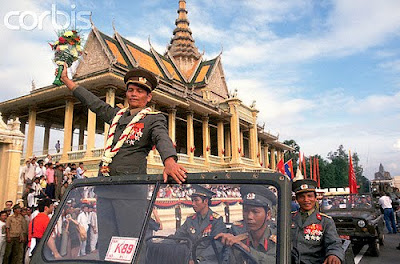
Vietnamese occupation troops in Cambodia
Friday, November 20, 2009
Op-Ed by Anonymous
I listened to His Excellency Var Kim Hong's explanation on the border issue with keen interest. What got me thinking most was the way he based his committee's works around the signed treaty of 1985, between a Vietnamese installed regime, signed under barrels of the guns and only to be re-signed again in 2005. Here right away, one should understand that we start this process from negative - some lands along the border had already been initially signed away to Vietnam since that 1985 deal.
The Cambodian people must demand that treaty of 1985 be trashed. This particular treaty is not legit since it was signed under occupation of 275,000 Vietnamese troops. This government at the time was not legitimate, or ever recognized by the United Nations. Therefore, the treaty is a one-sided story. Unfortunately, as a result of such illegal act, Cambodians along the border areas have already lost much of their productive land to Vietnam. Case in point, just listening to the actual people and victims of land loss who called in to point out areas and villages that ceeded to Vietnam since January 7, 1979. For example, Mr. Sothea from Kompong Cham called in to point out to His Excellency Var that there were land losses at sruk Meh Muth in Phum Che Kech, Prek Sla and Chrok Kreng due to Vietnam encroachment policy. In this recent event in Chantrea district, the government still continues to deny the facts even when poles were planted deep inside the land of our farmers. You can hear the pleas and testimonies on RFA from the victims themselves, but not in the eyes and ears of this highly pro-Vietnam government. What more do Mr. Var needs to hear or see in order to know that Cambodian farmers along the border are being subjected to Vietnamese aggressive policy of land's confiscation?
When asked about old map, old treaty of independence, Mr. Var Kim Hong pointed out that there are some issues with map selections in applying to his works. He questioned to a certain extend the validity and viability of the French maps recorded during and after Cambodia's independence of 1953. He refused to work with a Cambodian expert on border issue, Mr. Seng Peang Se, because Mr. Seng is not part of the government agency. Given the knowledge and expertise of Mr. Seng on the issue, one has to wonder why the government is keeping Mr. Seng out of the process. One because, I am sure Mr. Seng would have pointed out or insisted on where the borderline should be properly marked based on his own past records and understanding. Now, one has to wonder why Mr. Var Kim Hong and his CPP-lead government do not want a Cambodian expert on border issue to be a part of the committee? It seems rather odd for a responsible government to not seek advice of a highly respectable expert and scholar on this issue. The more His Excellency laid out his case in defense of his works, he gave me the impression that we can not trust the French map, but Vietnam's redrawing one. One caller asked, Mr. Poeu Pheap, "Why poles were always allowed to plant deep inside Cambodian territory?"
On the question of the Paris Peace Accord 1991, the government gave very little significance to the signed documents concerning territorial integrty of which Vietnam was one of the signatories. It was just not something can be referred to on this particular matter. The Cambodian government does not want to refer to the 1953's map because in its view that it's not doable since it could create some problems with our neighbors. So, it prefers to continue its appeasement policy while Cambodian farmers along the Eastern frontier continue to face their future of uncertainties as a result of on-going land confiscation.
As I say again and again with conviction and understanding that, when it comes to defending the interests of Cambodians and our nation, Sam Rainsy Party is there. But, when it comes to defending Vietnam's interests and its territorial expansionism policy, you know who or what I am talking about.
One thing that we have be clear is that we do not have any qualms or whatsoever with the people of Vietnam. We do, however, have certained issues related to Vietnam's hegemonic policy as evidently shown in this case of recent land encroachment activities in Chantrea.
Khmer Rouge Tribunal Asked to Define Victim Reparation
By Kong Sothanarith, VOA Khmer
Original report from Phnom Penh
20 November 2009
The Cambodian Human Rights Action Committee (CHRAC) and a London-based rights group, Redress, urged the Khmer Rouge Tribunal on Friday to show respect for the principle of reparation and make funds available for the regime’s survivors.
The groups insist on having victims participate in the discussions about reparations with the court, and that judges should issue an order about reparations and explain ways to find funds for it.
“We want to know clearly from the Khmer Rouge tribunal regarding the reparation,” said Hang Chhaya, director of Khmer Institute for Democracy and coordinator of the CHRAC.
But Reach Sambath, head of public affairs of UN-backed court, said the court is not yet in a position to thoroughly review the issue of reparation.
“The court is now working on Duch’s case,” he said, referring to case 001 against a notorious former Khmer Rouge prison chief. “And that issue has not been discussed in details yet.”
read more “Khmer Rouge Tribunal Asked to Define Victim Reparation”
Original report from Phnom Penh
20 November 2009
The Cambodian Human Rights Action Committee (CHRAC) and a London-based rights group, Redress, urged the Khmer Rouge Tribunal on Friday to show respect for the principle of reparation and make funds available for the regime’s survivors.
The groups insist on having victims participate in the discussions about reparations with the court, and that judges should issue an order about reparations and explain ways to find funds for it.
“We want to know clearly from the Khmer Rouge tribunal regarding the reparation,” said Hang Chhaya, director of Khmer Institute for Democracy and coordinator of the CHRAC.
But Reach Sambath, head of public affairs of UN-backed court, said the court is not yet in a position to thoroughly review the issue of reparation.
“The court is now working on Duch’s case,” he said, referring to case 001 against a notorious former Khmer Rouge prison chief. “And that issue has not been discussed in details yet.”
Blaze destroys more than 200 homes

Photo by: Heng Chivoan
Hundreds of Cham Muslims were left homeless on Thursday morning when a fire tore through a crowded neighbourhood in Phnom Penh, incinerating more than 200 homes and causing ammunition in a police station to explode. Despite the intensity of the inferno, no one was killed.IT was a scene of destruction Thursday morning as a raging fire set light to more than 200 homes in Russey Keo’s Chraing Chamres II commune and left even the local police station and commune hall destroyed.
The morning saw residents frantically trying to salvage what possessions they could from the roaring blaze.
“Help my home! Help my home!” Samrith Sary cried as fire trucks, sirens wailing, pulled into the street. She ran back and forth on the road, lugging plastic containers filled with water and throwing the liquid on the walls of her burning home.
As the fire continued to spread, loud explosions could be heard from inside the burning police station as bullets and ammunition ignited.
Elsewhere along National Road 5, parents called out to their children while police officers stopped trucks hauling canisters of oil and gas from driving past.
The village’s densely packed houses hindered police and fire crews, who were left with only one metre of manoeuvring room in some parts.

Photo by: Heng Chivoan
Neighbourhood residents wash the soot from their hair and faces after Thursday’s blaze.Officials bulldozed some burning homes to allow fire trucks to enter, Phnom Penh Municipal Police Chief Touch Naruth said.
By Thursday evening, officials counted 229 homes torched by the fire.
No one was injured, commune Chief Vann Thorn said.
Officials said they did not know what started the blaze.
However, one eyewitness said she saw the first signs of smoke and fire coming from the home of the local medicine seller.
“There was a burning smell,” said Ly Mary, whose house was also ravaged by the blaze.
“I walked to the window. Suddenly, I saw the smoke and fire flow out from his house. After that, the fire spread to other houses,” Ly Mary said.
Govt seizes Thai airport firm
THE government took control of the Thai-owned aviation firm Cambodia Air Traffic Services (CATS) on Thursday and banned its Thai employees from the offices after the arrest of one of their co-workers on suspicion of stealing the flight schedule of fugitive Thai former prime minister Thaksin Shinawatra during his visit to Cambodia last week.
The move, which is likely to further damage diplomatic relations between the two countries, comes amid accusations by a Thai opposition leader that Thailand’s foreign minister ordered the theft.
CATS is a fully owned subsidiary of Bangkok-based Samart corporation, which has a 32-year air traffic control concession and employs nine Thai nationals in Cambodia.
It has been placed under the caretakership of a Cambodian government official, though representatives from the Civil Aviation Authority declined to comment on the official’s identity or the duration of the caretakership.
“The caretaker has prohibited the Thai expatriates from performing their duties,” Samart vice chairman Sirichai Rasameechan said in a letter to Thailand’s stock exchange, where the company is listed.
Council of Ministers spokesman Phay Siphan said Cambodia’s takeover of CATS was “temporary” but necessary “to ensure national security and public safety.” The financial operations of the company, he added, would not be affected.
The move follows last week’s arrest of CATS employee Siwarak Chotipong, a 31-year-old Thai accused of spying, who is currently being held in pretrial detention at Prey Sar prison.
Thaksin is not the prime minister of cambodia – he is a convicted man....
Cambodian officials say that Siwarak was ordered to steal the flight schedule by Kamrob Palawatwichai, the first secretary of the Thai embassy in Phnom Penh. Kamrob was expelled last week, and Thailand responded by expelling the first secretary of the Cambodian embassy in Bangkok.
Both countries had already withdrawn their respective ambassadors in the row over Thaksin’s appointment as government economics adviser.
Siwarak is being charged under Article 19 of the 2005 Law on Archives, which covers offences related to matters of national defence, security or public order. If convicted, he faces up to 15 years in prison.
Kav Soupha, Siwarak’s defence attorney, said Thursday that he did not believe that the leaking of Thaksin’s flight schedule constituted a threat to Cambodia’s national security.
“Thaksin is not the prime minister of Cambodia – he is a convicted man who is being hunted by Thai authorities,” Kav Soupha said. “Even if [Siwarak] had reported to the Thai embassy, that would be according to his right and obligation as a Thai citizen to alert authorities about a fugitive.”
Kav Soupha added that he planned to request that Siwarak be released on bail.
Jatuporn Prompan, a parliamentarian from the opposition Puea Thai party, said Wednesday that he had an audio tape of Thai Foreign Minister Kasit Piromya ordering the flight schedule theft of which Siwarak is accused, the Bangkok Post reported.
Thai Foreign Ministry deputy spokesman Thani Thongphakdi, however, said officials in his ministry “do not believe in the existence of such a tape”.
Cambodian Foreign Ministry spokesman Koy Kuong said he had no knowledge of such evidence.
Kasit said Thailand would have to gather further information about the CATS takeover before formulating a response.
“The ministry is waiting for reports from the Thai embassy and we will also have to get clarification from the Cambodian government. If it violates bilateral agreements, then we will find ways to proceed from there,” the Bangkok Post quoted Kasit as saying.
Secrecy ordered
As tensions between Thailand and Cambodia simmered, the government released a directive on Wednesday in which the Ministry of Interior called on all government officials to encrypt their communications to “protect information related to national security”.
The statement, signed by Interior Minister Sar Kheng on October 15, touted, without specifically describing, newly acquired encryption technology that will “guarantee secrecy, so that government information will not be leaked”.
Interior Ministry spokesman Khieu Sopheak said such measures were necessary in Cambodia’s present diplomatic circumstances.
“If Thaksin would have been arrested because of [Siwarak] leaking information about him, that would prove we could not keep sensitive information a secret.”
Evictees could face hunger as aid falls off

Photo by: Sovan Philong
A man lies on a mat in his makeshift home in Tuol Sambo earlier this year.THE United Nations and other organisations expressed renewed concern about access to food for the 40 HIV-affected families living at a relocation site in Dangkor district, and some said they fear standard food packages will be cut off after a three-month commitment from the World Food Programme concludes in January.
“In the current absence of secure livelihoods and therefore of income flows, access to more than the minimum food package (rice, salt, oil) is crucial,” reads a UNAIDS summary of a November 9 visit to Tuol Sambo, a copy of which was obtained Thursday.
The WFP began distributing standard food packages containing 30 kilograms of rice, 1 litre of vegetable oil and 1.5 kilograms of iodised salt on October 20. To supplement that, the NGO Caritas Cambodia is scheduled to begin its own three-month programme of food packages including sugar, fish, fish sauce and instant noodles on December 1.
But the president of an NGO involved in food distribution at the site said Thursday he was worried that only “10 or 15” families would be in a position to receive food after the three-month WFP commitment ends, adding that he hopes the WFP will commit to another year of food packages.
“I am worried that the WFP will not continue its help, and then we will meet with a big problem because we do not have enough support to help those families with HIV/AIDS,” said Chea Sarith, president of the Women’s Organisation for Modern Economy and Nursing (WOMEN).
His fears were matched by Mey Sovannara, communications and advocacy officer for the HIV/AIDS NGO Khana, which has also been involved in food distribution.
“If the World Food Programme no longer provides support, Khana will not have money to allocate food to them,” Mey Sovannara said, though he added that the NGO might be able to assist “some vulnerable children in Tuol Sambo who face food insecurity”.
Officials at the WFP country office could not be reached Thursday. UNAIDS Country Director Tony Lisle said discussions were ongoing about extending the WFP commitment, and he expressed confidence that families unable to support themselves would continue to receive food.
“I categorically guarantee that we will make sure that there’s no discontinuity in food,” he said.
Residents and rights workers, meanwhile, said access to food was a chief concern.
“The most difficult problem we are facing is the lack of food,” said 41-year-old Tuol Sambo resident Soun Davy. “It was better for my family before we moved to live in Tuol Sambo, because I had a job there and could earn money to buy rice.”
The HIV-affected families were relocated to Tuol Sambo over the summer in a move that was roundly condemned by rights groups.
Am Sam Ath, technical superviser for the rights group Licadho, said many of the families he had interviewed were short on food, adding that their new location some 17 kilometres outside the capital afforded them fewer scavenging options.
“It’s not the same for them now like in the city, when they could collect rubbish and take the money to buy food,” he said.
Phnom Penh Deputy Governor Mann Chhoeun declined to answer questions Thursday about the food situation at Tuol Sambo.
Some progress made
The UNAIDS site report highlights some progress at Tuol Sambo, noting in particular that residents have “satisfactory access” to health services and antiretroviral therapy, and that “access to water was not considered an issue”. The report also refers to “commendable” efforts by Caritas to involve 39 families in “income-generation opportunities”, mainly in construction, sewing and tailoring.
Though the report states that subsidised electricy was shut off on November 6, residents said Thursday that it had been restored.
Plans are also in the works to upgrade the housing stock and to further integrate the HIV-affected families with families living in a nearby riverside community.
In addition, Lisle said Thursday that Tia Phalla, deputy director of the National AIDS Authority, had told Prasada Rao, Asia and Pacific regional director for UNAIDS, in a meeting this week that the eviction of Borei Keila families to Tuol Sambo had been “a mistake, and that this would not be the way they would proceed in the future”.
Subscribe to:
Posts (Atom)


